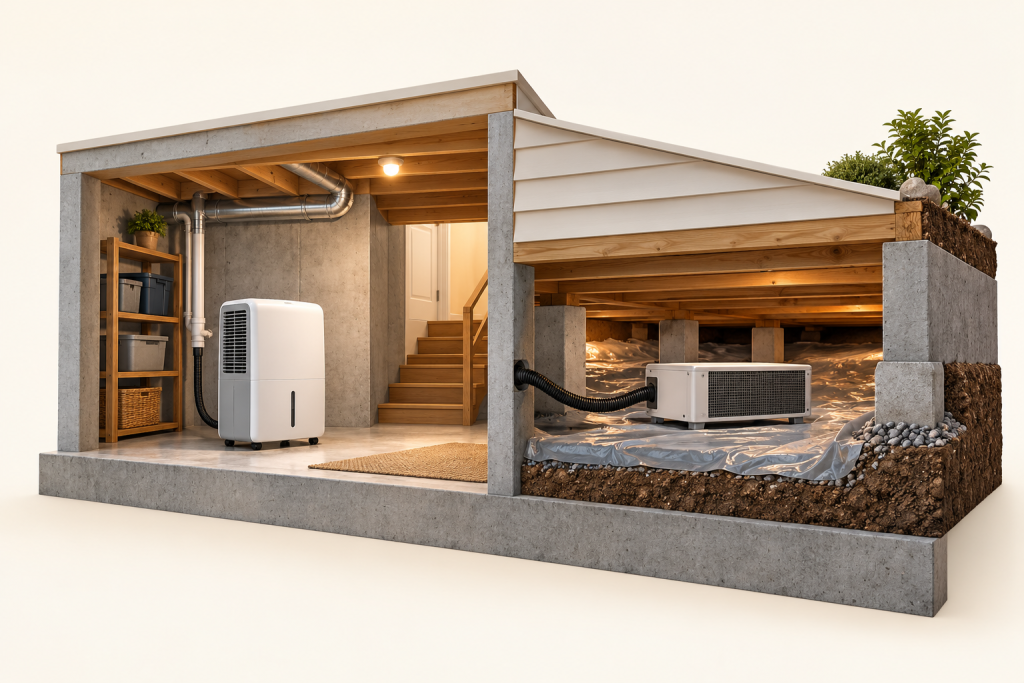
Choose between a crawl-space-style cabinet and a portable basement unit by how it will be installed and used. The label alone does not establish capacity, quietness, pump capability or efficiency. An accessible basement and a low, awkward crawl space can require different arrangements even when their moisture loads are similar.
Start with the ownership routine
ENERGY STAR distinguishes portable room units from typically permanent, duct-connected whole-home systems. Many portable units use a bucket, with hose drainage available on some models. A product marketed for crawl spaces should not automatically be treated as a ducted whole-home system; verify its actual installation options.
| Your routine | Format question to answer |
|---|---|
| You will empty a bucket yourself | Can you reach, remove and carry the full bucket without moving the appliance? |
| The space is hard to enter | Can condensate drain automatically, and can you still reach the filter and hose? |
| You need to move the unit between rooms | Does the actual weight, shape and handling arrangement suit that route? |
| The equipment will stay in one position | Will service and eventual removal remain practical after installation? |
| Several separated rooms need treatment | Is there a documented distribution arrangement, or are you assuming air will reach them? |
A pump is a feature, not a format
Do not choose a cabinet style as a shortcut for deciding drainage. Check whether the exact offer uses a bucket, gravity connection, built-in pump or an approved external arrangement. Then apply the drain-route decision to the actual location. A low final outlet does not resolve every obstacle along the hose path.
For a fixed-installation example, the Shield 85P manual, PDF pages 6 and 11–13 requires upright, level operation, specifies airflow clearance, describes pump and gravity arrangements, and offers a wired controller. Those features describe this model. They do not prove that every crawl-space cabinet has a pump or that a controller replaces physical inspection.
Compare candidates after choosing a workable arrangement
- Attach the rating conditions to each capacity figure; use the rating-label explanation before comparing different test bases.
- Check the operating-temperature range against the actual basement, including colder periods.
- Account for the cabinet, airflow and service envelopes using the fit worksheet.
- For an occupied room, ask for qualified noise evidence; cabinet shape and a commercial label are not acoustic measurements.
Our editorial recommendation is to retain whichever format makes routine drainage and maintenance realistic, then compare exact models within that workable arrangement. A portable unit with a suitable continuous drain can solve an emptying problem without a change of category. Conversely, easy-to-use controls do little good if the chosen installation prevents filter removal.
Reject an arrangement you cannot maintain
If neither arrangement provides access and a permitted discharge route, settle the installation before buying.