DrySpace Guide

  • Home
  • Reviews
  • Best
  • Guides
  • Comparisons
  • Favorites
Guides

Dehumidifier capacity ratings: saturation, AHAM and DOE explained

Understand saturation, AHAM and DOE dehumidifier capacity labels. Keep test conditions attached to pint ratings when comparing models.

2 min read
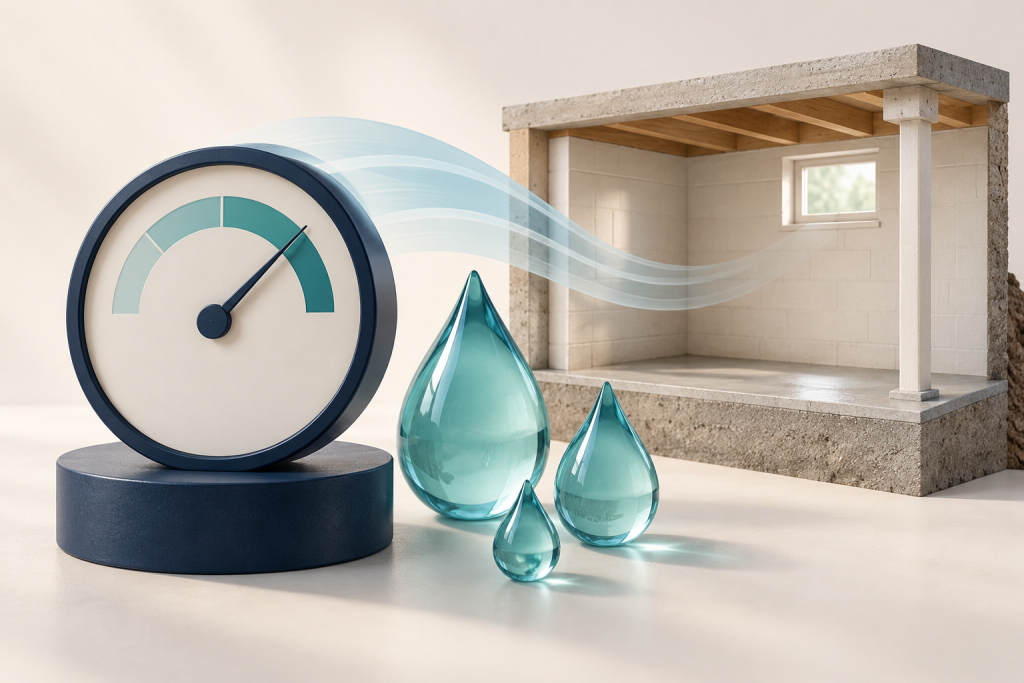
Conceptual humidity dial, water droplets and basement cutaway

Conceptual editorial illustration

Table of Contents

Before comparing pint ratings, write the test temperature and relative humidity beside each number. Without those conditions, a larger number may describe a different test rather than a stronger machine.

Read one label all the way through

Argendon’s Shield 35M specification gives 35 pints/day at 80°F and 60% RH, alongside 70 pints/day at saturation. Those are two descriptions of one model, not two competing products. The sheet does not establish that your home will collect either quantity every day. Read the specification sheet.

Worksheet entry Shield 35M example
Exact model Shield 35M
Removal rate and conditions 35 pints/day at 80°F/60% RH
Separate saturation claim 70 pints/day; keep out of the ordinary-condition column
What remains unknown Daily collection in your own space

ENERGY STAR explains that the newer portable test uses 65°F rather than 80°F, and that IEF includes energy used while the machine has cycled off. A change in testing can therefore reduce the stated capacity without making the hardware worse. Do not apply a portable-rating conversion to every crawl-space machine.

Which comparisons are valid?

  • 35 pints/day versus 70 pints/day on the same 35M sheet: two conditions, not two competing machines.
  • Two models rated at the same temperature and RH: a usable capacity comparison, although not a home-specific prediction.
  • An older 80°F portable label versus a newer 65°F label: check the test change before judging the hardware.
  • Pints/day versus IEF: different measurements; IEF describes water removal per unit of energy and includes off-cycle energy in the test.

An unknown test basis stays unknown

Keep an unresolved test basis marked “unknown.” Do not invent a conversion or treat a saturation claim as a substitute.

Once the labels are comparable, use the crawl-space assessment or the basement replacement diagnosis to decide what the capacity needs to accomplish.
Frequently Asked Questions

Is a 70-pint saturation rating the same as 70 pints/day in a basement?

No. It is a rating under a different stated or advertised condition. Check the equivalent-temperature and humidity rating before comparing models.

Can I convert every old rating by the same percentage?

No. Test categories and individual products differ. Use a documented rating for the exact model rather than a universal conversion.

Share this article

Twitter Facebook LinkedIn Email

Related Articles

Conceptual illustration: Pump lift versus drain-hose length: checking the discharge route

Pump lift versus drain-hose length: checking the discharge route

Read More
Conceptual illustration: How to plan a continuous downhill dehumidifier drain route

How to plan a continuous downhill dehumidifier drain route

Read More
Conceptual illustration: Where to place a dehumidifier in a basement

Where to place a dehumidifier in a basement

Read More

About DrySpace Guide

Dehumidifier reviews, comparisons and practical moisture-control guides.

We use manufacturer documentation and attributed owner reports. We do not claim hands-on testing or assign unsupported scores. Our initial product coverage focuses on Argendon.

Quick Links

  • Home
  • All Reviews
  • Best Articles
  • Comparisons
  • Guides
  • About
  • Contact
  • Privacy Policy

Categories

  • Crawl-space dehumidifiers

© 2026 DrySpace Guide. All Rights Reserved.

We may earn a commission from qualifying purchases through our Awin affiliate links. Our articles distinguish documented facts, owner reports and editorial judgments. Affiliate disclosure