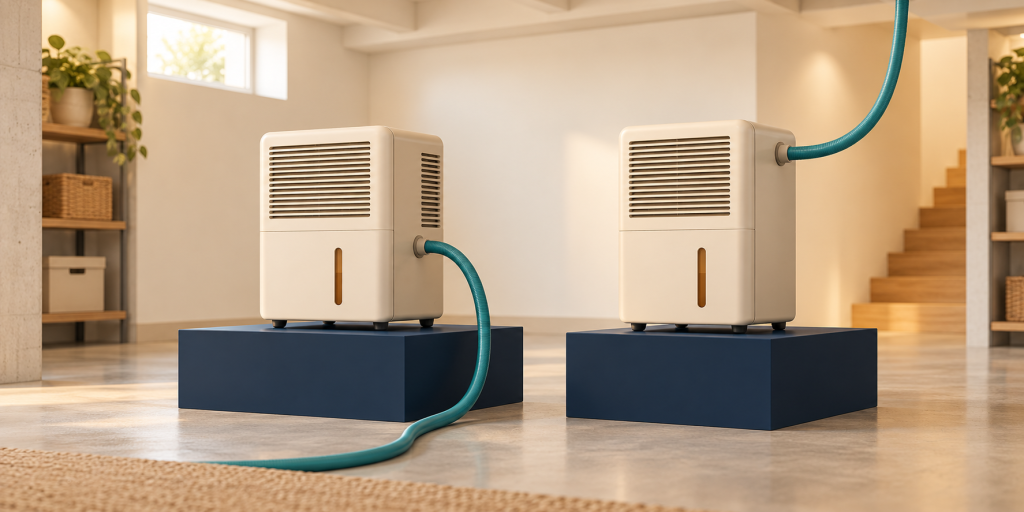
Sketch the hose route before choosing pump or gravity drainage. Gravity is a candidate only when the entire path can descend to an appropriate discharge point; a rising section requires a different arrangement.
Check your proposed hose route
Measure the outlet, obstacles and final destination before selecting a drain type.
This checks route logic only. Confirm model-specific lift, hose and discharge requirements.Mark the high point, not just the destination
- Mark the drain outlet height in the intended supported position.
- Trace every bend and obstruction to the destination.
- Circle any uphill section, even if the final destination is below the machine.
- Confirm an appropriate building discharge connection; a hose diagram is not plumbing-code approval.
If the route rises
Obtain the exact model’s permitted pump lift and routing restrictions. Hose length and vertical lift are separate measurements: a supplied 19.6-foot hose is not permission for a 19.6-foot rise. Leave access to inspect and secure the connection.
The Shield 85P manual, drainage section distinguishes gravity and pump arrangements and requires the unused gravity opening to be plugged for pump use. Its instructions are model-specific: do not transfer button presses, hose connectors or fault resets to another model.
If the route descends throughout
Gravity may meet the requirement without using a pump. Check that the installed hose retains the intended path rather than relying on the sketch alone. Shield 35M versus 35P shows how a shared capacity class can leave drainage and control as the deciding differences.
Commission the route you actually built
- Observe water reaching the destination during an actual discharge cycle.
- Inspect connections for leakage and check that the hose stays in position.
- Repeat after moving the unit or servicing the hose.
- For leakage or a drainage alarm, stop and follow the correct manual; do not bypass the fault.
One successful drain cycle is a starting check
A successful first cycle verifies that arrangement at that time. It does not establish that the hose can never clog or that a pump needs no later inspection.