There is no single daily runtime that demonstrates a basement dehumidifier is working correctly. The useful question is whether it maintains the intended humidity under the current conditions and behaves as its control mode specifies. A fixed eight-hour rule cannot answer that for every room or machine.
What do you mean by “running”?
A lit display, audible fan and active compressor are not interchangeable observations. GE’s fan-operation guidance describes a fan continuing briefly after compressor shutdown and running during defrost. Its timing applies to the units covered by that guidance, not every brand. Record the displayed state rather than diagnosing compressor operation from fan noise alone.
| Observation | Interpretation to check |
|---|---|
| It stops after reaching the target, then starts later | Compare this with the manual’s humidity-control behavior. |
| It continues after the room reaches the target | Confirm whether continuous mode or another control mode overrides the RH setting. |
| The fan runs while removal pauses | Check for a documented delay or defrost state. |
| It operates for long periods and the room remains damp | Investigate the conditions, drainage and air distribution rather than selecting a shorter timer. |
Continuous mode changes the question
The Shield 85P manual, PDF pages 9–11 distinguishes humidity control, continuous operation and GPP control. In its continuous mode, the unit operates independently of changes in RH; the manual also describes a compressor restart delay. These are reasons to check the active mode before concluding that long runtime means a fault.
For routine humidity control, follow the exact model’s automatic-control instructions. Do not enter a new RH target and assume it governs the machine while another mode has priority. The basement setting guide covers choosing and observing the target; this page concerns what the resulting operating pattern means.
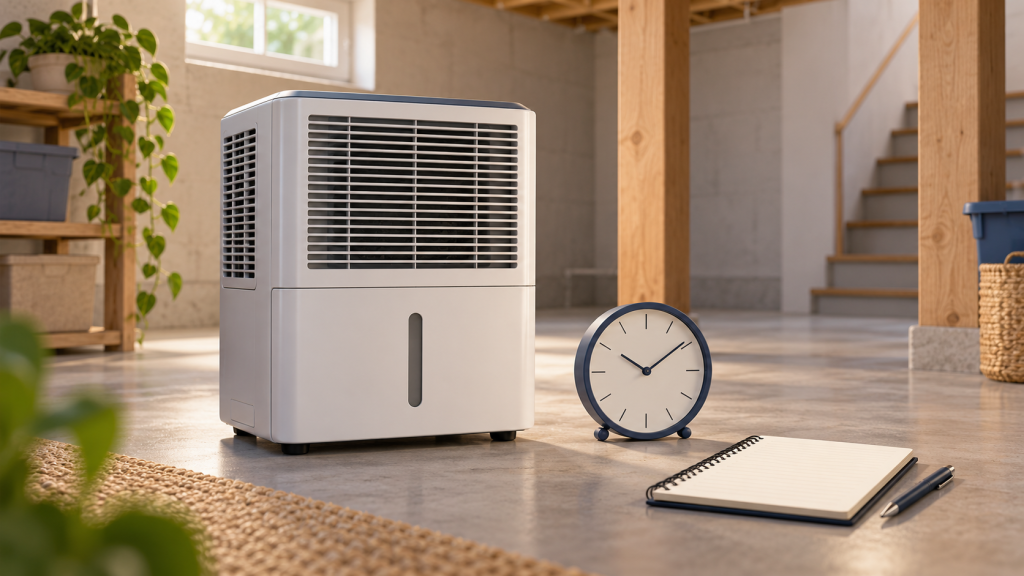
Keep a runtime note that can explain a change
- Record mode and target, plus room humidity and temperature at the beginning and end of your observation.
- Note fan-only, defrost, standby and fault indications where the model provides them.
- Record drainage interruptions and changed conditions such as open doors or unusual moisture entry.
- If budgeting, measure energy over the period rather than counting every audible hour as full-power operation.
Our suggested record is an observation aid, not a diagnostic test with a guaranteed completion time. It lets you compare like with like: long operation with falling humidity is a different situation from long operation with no improvement and a repeated fault.
Choose follow-up from the operating result
- When the unit behaves outside its documented controls, use the manufacturer’s support process.
- If it runs but removes no water, follow the separate diagnostic sequence. If the humidity result is satisfactory and the concern is cost, calculate energy charges from measured kWh before imposing a timer that changes the result you were trying to maintain.