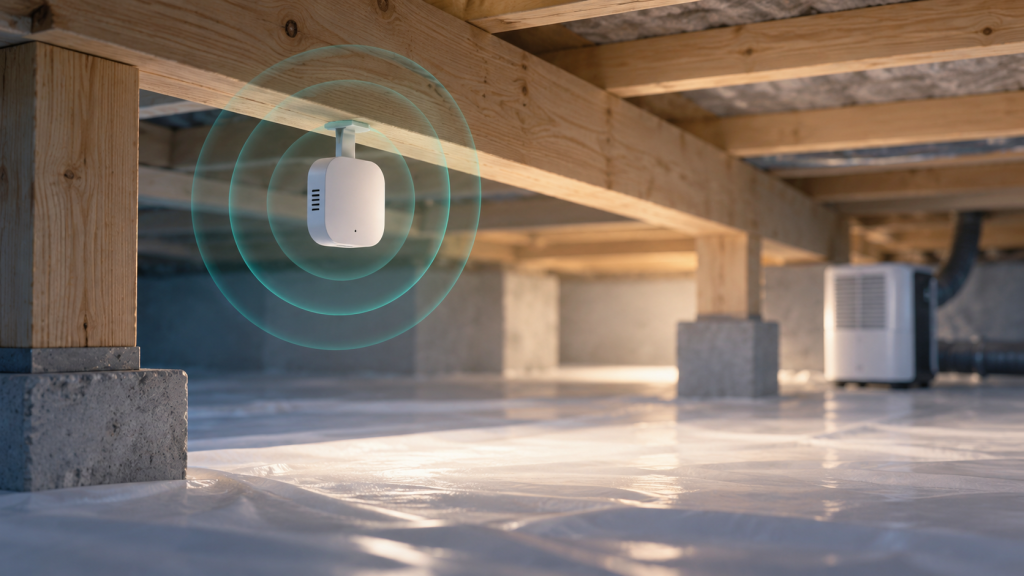
Decide what the humidity reading needs to tell you before choosing a place for the sensor. A reading beside the dehumidifier answers a local question; it does not establish conditions in a remote bay. The location should represent the area you are trying to assess.
Choose the question before the location
| Measurement purpose | Location strategy |
|---|---|
| Track the general crawl-space condition | Use a representative accessible point away from a strong local heat or air source. |
| Investigate a damp remote bay | Add a clearly labeled observation there; retain the original location for comparison. |
| Control the dehumidifier remotely | Use only a compatible sensor/controller and the manufacturer’s prescribed installation. |
| Compare the machine display with another meter | First compare nearby readings under similar conditions; different locations are different measurements. |
Vaisala’s installation guidance explains that restricted airflow, nearby heat and incorrect wall-sensor orientation can bias readings. This supports the measurement principles here; it does not prescribe a universal crawl-space height or authorize mounting every sensor against masonry.
Keep a short location record
- Label the position so a later reading comes from the same place.
- Record temperature alongside relative humidity.
- Note nearby outlets, ducts, pipes or surfaces that could affect the local measurement.
- Keep the instrument clear of water contact and within its specified environment.
- Allow it to settle according to its own instructions after relocation.
Avoid moving the only sensor every time the number looks surprising. That changes both the location and the observation period. A more useful investigation retains one reference position and records any additional measurement separately. This is an observation method, not a calibration procedure.
What a disagreement means
Two different readings can reflect location, temperature, instrument accuracy or response time. They do not by themselves prove that the built-in humidistat is faulty. Note the size and direction of the difference, compare the instruments’ stated tolerances, and consult their instructions before applying an offset.
When a remote controller is a different purchase
A standalone meter can report RH without controlling anything. A wired controller may change settings but use a sensing point defined by the equipment design. Confirm where the controlling sensor actually is before assuming that a display upstairs measures the air upstairs.
Keep a reference location while investigating another bay
Once you have a dependable observation location, the crawl-space monitoring guide covers following the pattern over time.
If the far area remains different, review machine placement and air paths rather than concealing the difference by moving the sensor next to the outlet.