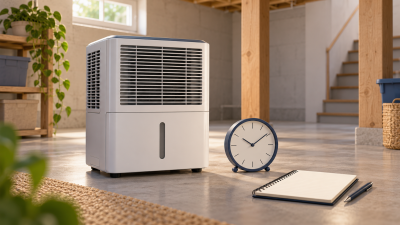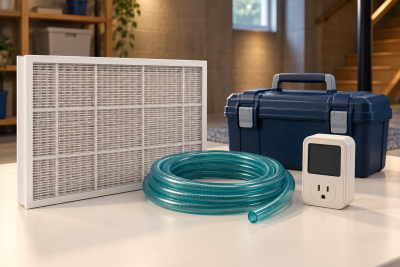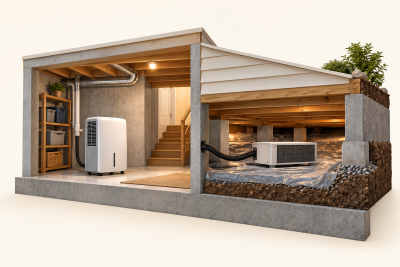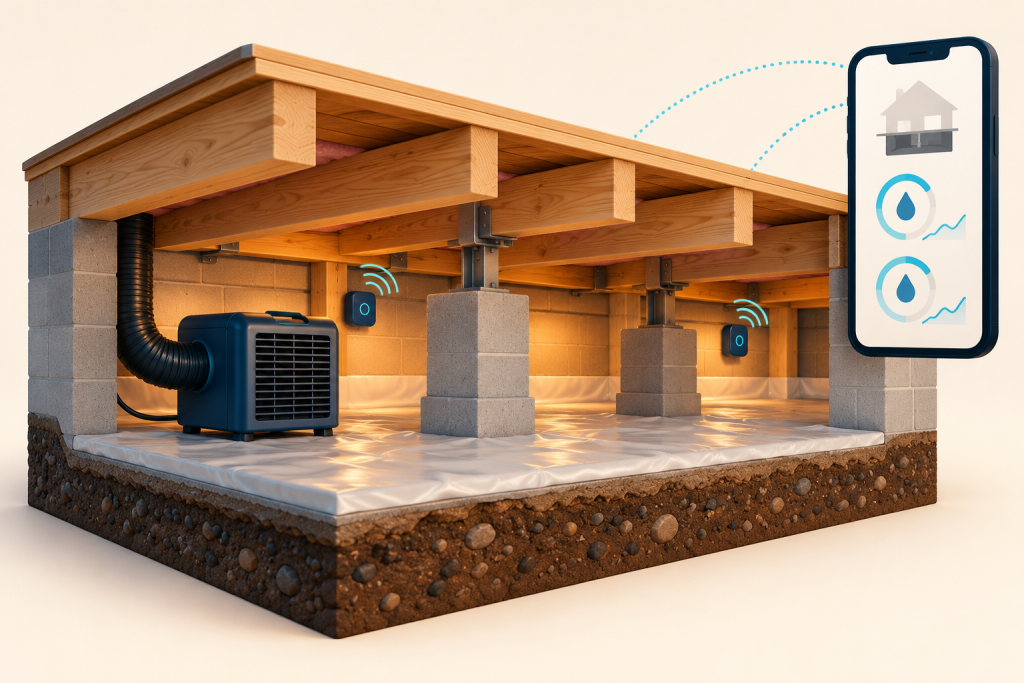
A crawl-space display tells you about a sensor, not every bay under the home. Use a moderate target as the starting point, then compare readings near the machine and in a remote section before changing it.
EPA’s general indoor moisture guidance is below 60% RH, ideally 30–50% where possible. Applying a 50% starting point to a crawl-space monitoring plan is an editorial starting recommendation, not a special crawl-space code or a guarantee against moisture damage. Read EPA’s guidance.
Read the pattern across locations
| Observed pattern | Question to investigate |
|---|---|
| Near the machine reaches target; remote bay remains damp | Is air reaching that bay, or is there a local moisture source? |
| Both locations remain high | What moisture entry, operating conditions or drainage interruption is affecting the space? |
| The machine continues despite the entered RH target | Which operating mode and sensor are governing it? |
Take readings away from direct discharge air and note temperature, rain, outdoor-air entry and plumbing changes. Repeatedly lowering the target can over-dry the near area while leaving the remote problem unresolved. The crawl-space site brief provides a place to record those enclosure and distribution conditions.
Confirm what actually controls operation
On a machine with continuous, GPP and ordinary humidity-control modes, first confirm which mode is active. The Shield 85P manual describes different control priorities; entering an RH number is not enough if another mode governs operation. See the function description in the Shield 85P manual.
An optional wired controller can make readings easier to access, but it does not automatically create whole-space monitoring. Confirm which sensor governs operation and where it is located for the exact setup. Do not infer Wi-Fi or app alerts from the words “remote controller.”
Keep a commissioning and monitoring record
- Record the mode, target and sensor locations at commissioning.
- Confirm that condensate reaches the destination without leaking.
- Compare later readings at the same locations and annotate seasonal or weather changes.
Request an assessment: Have persistent dampness, standing water or inaccessible sections assessed instead of raising the target to 70% just to stop runtime.