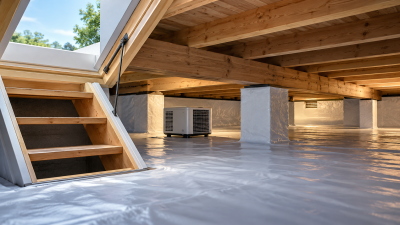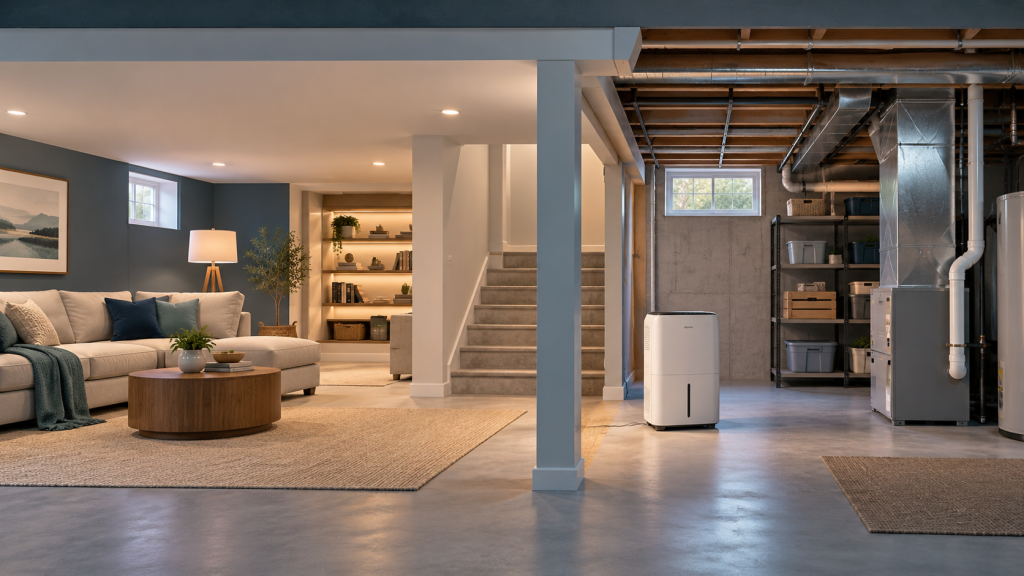
You have a promising spot beside the drain and another near the damp area. Compare both against the same practical requirements: air circulation, a permitted discharge route and access for maintenance. The center of the basement is not automatically the winner.
Compare two candidate positions
| Question | Near the drain | Near the damp area |
|---|---|---|
| Can air circulate through the intended space? | Check walls, storage and room divisions. | Check whether the location is isolated from the rest. |
| Can the machine drain as documented? | Short distance still needs a valid route. | A longer or rising route needs separate assessment. |
| Will people use the space comfortably? | Check walkways and nearby seating. | Consider warm discharge and sound near activities. |
| Can you service it without moving everything? | Leave filter, controls and connections accessible. | Avoid trapping the cabinet behind furniture. |
ENERGY STAR’s use guidance emphasizes free air circulation and following the product’s installation instructions. It also notes that dehumidifiers warm the surrounding air. Do not choose a seating-area location on the assumption that the appliance will act as an air conditioner.
Treat separate rooms as separate observations
A reading in an open utility area does not establish the condition in a closed storage room. Map the rooms you actually intend to control. If access doors normally remain closed, do not assume the same result as an open layout. Any change to ducting or the building’s HVAC arrangement needs an appropriate design; this is not a recommendation to cut transfer openings.
Check the spot before moving a heavy cabinet
- Confirm the exact operating-temperature range for that part of the basement.
- Reserve the manual’s intake and outlet clearances.
- Plan a permitted outlet and drain arrangement without creating a walkway obstruction.
- Check that filters and the control panel remain reachable.
- Record a representative baseline away from the immediate discharge stream.
A published cabinet width is not a clearance specification. Where documentation uses conflicting units or distances, obtain clarification rather than choosing the smaller number because it fits. The cabinet-fit guide separates access measurements from operating space.
What to observe after installation
Compare humidity and temperature at the same location under similar conditions, note the active mode, and check accessible drain connections. If a separate area remains damp, investigate the air path and moisture source before moving the machine repeatedly or lowering the target.
Choose the usable position, then assess its result
Choose the location that satisfies all three practical needs: air access, drainage and maintenance.
Then use the basement settings guide to assess the result. If temperature is the main constraint, cold-basement performance is the next question rather than finding a more central corner.