Before replacing a basement dehumidifier with a larger one, describe why the current arrangement is failing. A full bucket, a closed room and a machine that runs without reaching the target point to different decisions.
Start with the observed problem
| Observation | Next check before sizing up |
|---|---|
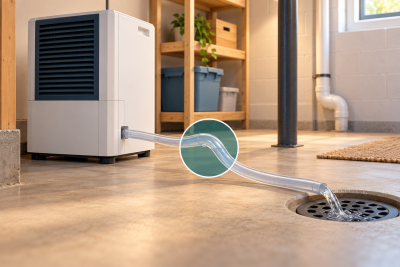
| It stops when the bucket fills | Would a suitable continuous drain remove the interruption? |
| The open basement improves but a separate room does not | Can air reach that room during normal use? |
| It runs without reaching the target | Check water entry, temperature, airflow and drainage; document the conditions. |
| There is standing water or wall seepage | Address the water source; do not reduce the problem to a pint-rating choice. |
Measure the basement as it is used
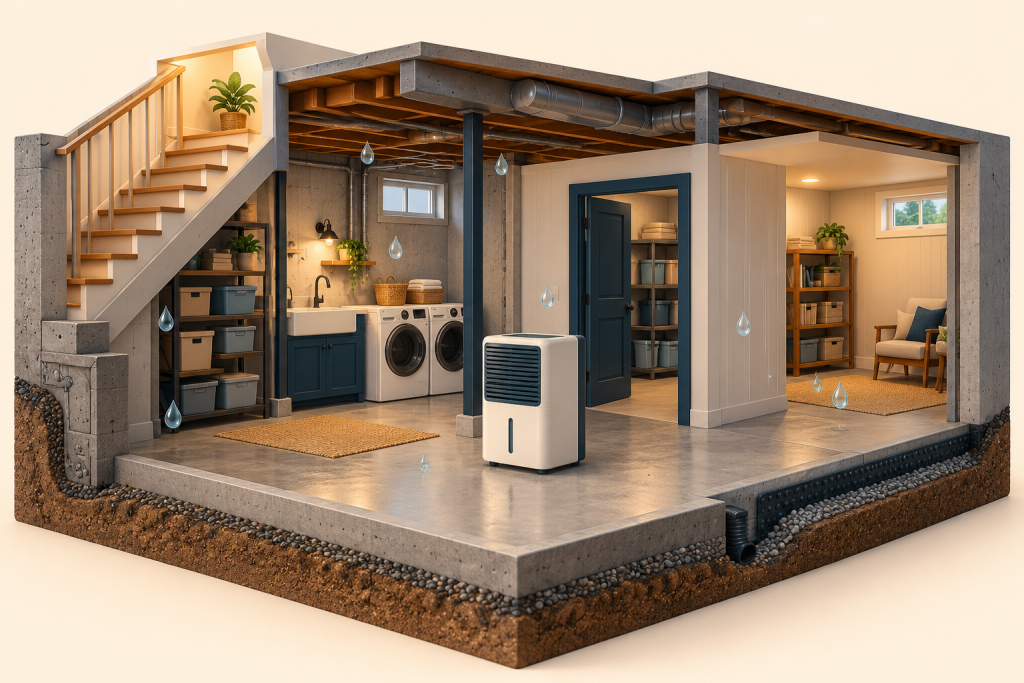
Map the connected area and normally closed rooms. Record typical temperature and dampness, and identify whether the location is storage, a workspace or another occupied room. A cabinet beside a desk has a different noise consequence from one in unused storage, even if both areas have the same floor size.
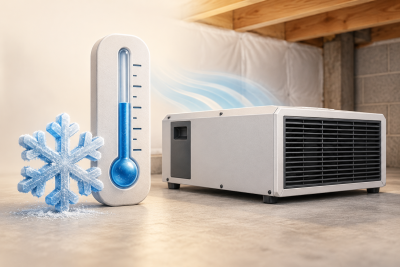
ENERGY STAR’s portable-dehumidifier guidance groups recommendations by floor area and dampness. It also flags low-temperature suitability when a space regularly falls below 65°F. These are screening considerations, not an exact load calculation for an installed crawl-space-style machine.
For each candidate, keep capacity and test conditions in the same worksheet cell. The rating-label guide explains why a saturation headline cannot be compared directly with a current portable rating. Then record the proposed position, filter access and complete hose route.
Define what successful replacement would look like
- The relevant rooms reach and maintain the intended humidity under the observed conditions.
- Water removal is not interrupted by an avoidable emptying or drainage problem.
- Noise and access are acceptable for the room’s normal use.
- Measured energy use is considered alongside the humidity result, not in isolation.
Judge the replacement in the rooms it must serve
After installation, check the occupied or stored-goods area as well as the display.
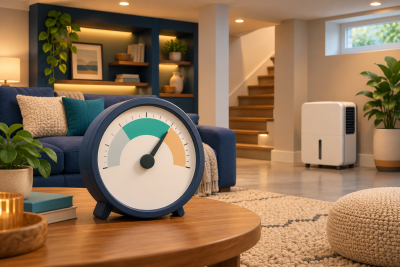
The basement setpoint guide helps interpret those readings without repeatedly changing several settings at once.