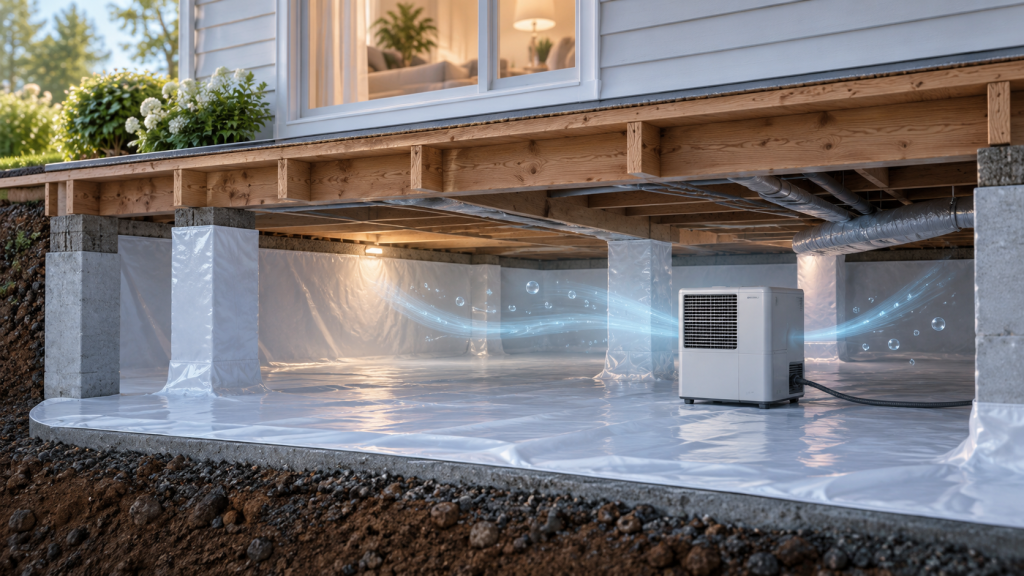
An encapsulated crawl space already has an installation history. Find out what was intended to dry it before deciding that it needs another appliance. Keep an effective existing drying arrangement; investigate persistent humidity in the enclosure and drying provision together.
Start with the installed design
Ask the installer to identify the intended drying mechanism and its controls. Building America’s crawl-space assessment guidance calls for a drying mechanism and discusses conditioned-air strategies as well as dehumidification. A liner is part of moisture control; it is not an active moisture-removal appliance. Changes involving ventilation, HVAC or combustion appliances need assessment by the appropriate professional.
| Existing situation | Useful next step |
|---|---|
| Documented drying provision; humidity remains controlled | Keep observing performance and maintaining that system. |
| No clear explanation of how the sealed space dries | Request the installation design and a qualified assessment. |
| Humidity rises despite the intended drying provision | Check moisture entry, operating controls and distribution before selecting more equipment. |
| Standing water or an active leak | Address the source; a dehumidifier is not the repair. |
Make the observation representative
One reading immediately beside the machine cannot show that distant bays are controlled. Record RH and temperature at a consistent representative location, then compare another area if the layout is divided. Our sensor-placement guide explains how to avoid giving the instrument a misleading local microclimate.
For an editorial decision record, note the location, date, weather, RH, temperature and whether the installed drying system was operating. The purpose is to identify a recurring pattern, not to declare the system adequate from a single dry afternoon. Use the target established for your building and equipment; this is not a replacement design specification.
When a separate dehumidifier becomes a sensible proposal
- The enclosure and water-management defects have been assessed, yet the existing drying provision is not maintaining the intended conditions.
- The designer identifies dedicated moisture removal as the appropriate drying mechanism.
- A suitable location, service access and permitted continuous drainage route can be provided.
At that point, size the equipment for the actual moisture load and operating conditions. The sizing worksheet keeps capacity, test conditions and installation constraints separate. Buying the largest headline pint rating before checking those constraints can leave the same enclosure or distribution problem unresolved.
What to request from the encapsulation contractor
- The intended drying mechanism and control target.
- Where performance should be checked after installation.
- Who maintains the equipment, drainage and enclosure.
- What observations should trigger a return visit.
Keep the existing drying system or reassess it
Keep an effective existing drying arrangement. Add dedicated dehumidification when the building assessment and observed conditions justify it.
If you are still deciding whether the space should be encapsulated, start with the crawl-space assessment rather than using this post as an encapsulation specification.