Argendon Sandidry 55C review
Argendon Sandidry 55C research review covering documented capacity, drainage, controls and owner observations, with installation limits disclosed.
A documented capacity step above the compact 35-pint models, with pump drainage and a larger cabinet; owner reports expose hose-access and noise compromises.
At a Glance
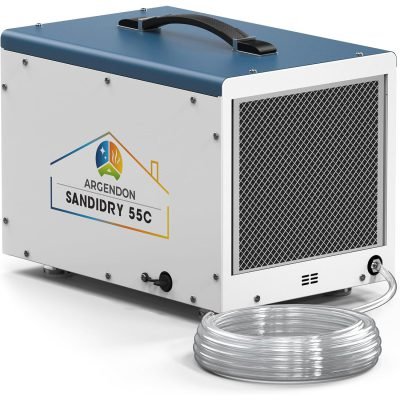
Manufacturer image · Argendon
KEY FEATURES
- Four-button panel with humidity, continuous and GPP modes
- Gravity and built-in pump drainage
- Automatic restart after power is restored
- Replaceable MERV-1 filter
- 55 pints/day at 80°F / 60% RH
Editorial assessment
Research-based conclusions · manufacturer documents and attributed owner reports
Moisture control
A documented capacity step
The 55-pint rating at 80°F/60% RH supports comparison with the 35P. The larger saturation headline is not a household drying forecast.
Drainage usability
Two routes; connector access matters
Pump and gravity options are useful, but an owner’s hose-access complaint makes the connection a placement check, not an afterthought.
Installation & service access
Allow space beyond the cabinet
Plan the turn beyond the hatch, filter withdrawal and hose access. The longer cabinet and roughly 44-pound weight affect the handling decision.
Running-cost evidence
Electrical figures need care
Current differs between the sheet’s table and prose. Favorable owner impressions do not establish a measured running-cost advantage.
These are editorial judgments, not measured performance scores or customer stars. Read the supporting analysis.
PROS
- Higher documented capacity than the 35P at matching conditions.
- Pump and gravity drain options.
- Early crawl-space reports describe useful operation.
CONS
- Hose connection access drew a specific complaint.
- Noise reports conflict.
- Heavier and longer than the smallest candidates.
Price and availability subject to change
Sandidry 55C trades a longer cabinet for a documented capacity step above Shield 35P.
That is useful only if the extra capacity is needed and the installation still leaves room to connect, inspect and service it. This review concerns Sandidry 55C, not Sandidry Pro 55C.
Its specification gives 55 pints/day at 80°F/60% RH and 120 at saturation. Those figures support a documented capacity increase over the Shield 35P, not a guarantee that every 1,300- or 1,500-square-foot space will be controlled.
Treat the hose connection as part of the footprint
The sheet gives a 17.64 × 11.69 × 11.85-inch cabinet.
- A height-only check misses two constraints: turning beyond the hatch and reaching the drain connector once the unit is supported.
- Before settling on a position, allow space for the connection and full filter withdrawal as well as airflow.
The owner analysis below includes a specific hose-access complaint. It is a reason to inspect the connection, not permission to leave it incompletely secured. The roughly 44-pound weight also belongs in the handling plan; the page and PDF give slightly different values.
Which claims should drive the upgrade?
| Use in the decision | Do not substitute |
|---|---|
| 55 versus 35 pints/day at matching test conditions | The 120 versus 70 saturation headlines |
| A measured access route and reachable connector | The word “compact” |
| Noise tolerance at the intended location | Positive customer stars as an acoustic test |
Coverage claims disagree between the page and PDF, and current differs between the sheet’s table and prose. Neither discrepancy should be resolved by choosing the figure that makes the purchase look easier. The 35P/55C comparison examines the actual capacity-versus-access tradeoff; the detailed analysis here retains both favorable use reports and the contrary noise report.
The owner evidence discussed below comes from manufacturer-hosted customer reports for this model. It is not an independent test or a representative reliability survey.
Pros & Cons Analysis
Research sources and limitations are described in this review.
Pros
A 55-pint versus 35-pint rating at the same air conditions is a meaningful equipment distinction.
It supports examining the 55C for a greater assessed load, but is not a home-specific sizing calculation.
Both discharge arrangements are documented.
This keeps the choice centered on the available route, while owner experience reinforces checking the physical connection before committing to a location.
Mark’s four-month crawl-space account provides a concrete use context.
It is more relevant than generic praise, though still short and hosted by the seller.
Cons
The hose-access complaint is actionable: confirm that your hand and the connector fit once the cabinet is supported.
An insecure joint is not an acceptable compromise for unattended operation.
MARY’s contrary noise report prevents a blanket recommendation for quiet occupied areas.
Placement and expectations should be discussed alongside nominal capacity.
The handling complaint agrees with treating this as a stationary installation.
Verify the route into the space and assistance needed before relying on a handle to make relocation easy.
The 55C capacity-versus-access decision
When the capacity step fits
Choose the Sandidry 55C when the assessed load justifies the capacity step and its longer cabinet still leaves drain and filter access.
When access favors 35P
Prefer the 35P when access is the limiting factor and its capacity is sufficient.
Avoid headline-only choices
Do not choose the 55C merely from a coverage-area headline or an unmeasured claim about low electricity use.
Frequently Asked Questions
Is Sandidry 55C the same as Pro 55C?
No. They are separate catalog identities; use the correct manual and owner evidence for each.
Which coverage area is guaranteed?
Neither conflicting marketing figure is a guarantee for a particular home. Assess moisture load, temperature and enclosure conditions.
Technical Specifications
| Removal capacity at 80°F / 60% RH | 55 US pints/day — 80°F / 60% RH |
|---|---|
| Advertised saturation capacity | 120 US pints/day; separate saturation claim |
| Drainage options | Gravity or built-in pump |
| Built-in condensate pump | Yes |
| Documented pump lift | Not verified; hose length is not lift |
| Humidity control type | Digital; 25–80% in specification |
| Selectable humidity settings | Digital; 25–80% in specification |
| Remote control support | Optional wired controller |
| Unit dimensions (L × W × H) | 17.64 × 11.69 × 11.85 in |
| Unit weight | 44.4 lb PDF; 44.53 lb page |
| Required airflow clearance | Exact clearance not verified |
| Rated airflow | 153 CFM; manufacturer claim |
| Stated operating temperature | 33–105°F; not an independent low-temperature performance test |
| Power supply | 115 V / 60 Hz |
| Rated current | Conflict: 3.51 A specification table; 3.1 A specification prose |
| Published efficiency metric | COP labels not treated as IEF or measured household savings |
| Published sound pressure | <57 dBA in specification; conditions unspecified |
| Filter rating | MERV-1; confirm exact replacement identity |
| Refrigerant | Current unit revision not verified |
| Warranty coverage | Limited terms; obtain current offer-specific coverage and exclusions |
| Independently checked certification | Exact-model registry check pending; no ENERGY STAR claim adopted |